• Skip to main content
  • Skip to primary sidebar

FaithSearch Bible Learning Center

“Be diligent to present yourself approved to God as a workman who does not need to be ashamed, handling accurately the word of truth.” 2 Timothy 2:15

  • About
    • Why?
      (Perspective)
    • What?
      (Features)
    • How?
      (Strategy)
    • What learners
      Are Saying
  • FAQ
  • Courses
    • Student Dashboard
    • Revealing the Fingerprints of God
    • DISCOVERY
    • Growing Faith
  • Enroll
  • Resources
    • How to Know God
    • Articles
    • Videos
    • Small Group Study
  • Contact
  • Login
  • FaithSearch Int’l.

    • Articles and News

Happ-O-Getics Newsletter

Sep 10 2025

The Ophel: Facilitating Jerusalem Pilgrimage

In the previous issue of this Happ-O-getics newsletter (July 2025) I presented evidence from the current excavation of the City of David which demonstrates proof of Israel’s ancient occupation of Jerusalem and Palestine. I want to follow up with news of the discoveries from current archaeology in the area between the foot of the Temple Mount to the north and the City of David to the south, an area known as the Ophel. The history of this site stretches back at least into the First Temple period of the eighth century B.C. (cf. 2 Chronicles 27:3; Nehemiah 3:26-27). Back then it was primarily significant for military defense, but just before and at the time of Jesus it functioned to facilitate pilgrimage to Jerusalem.
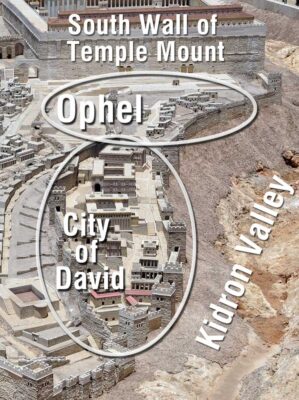
From a model of first century Jerusalem, the view looking north at the City of David (I.e. the old ancient core of Jerusalem). The area just outside the south wall of the Temple Mount is known as the Ophel. (Credit: holylandphotos.org)

This pilgrimage was fundamental to Jews in Palestine and the Diaspora from 1 B.C. – A.D. 1. (For confirmation, see the many countries represented in Jerusalem at Pentecost in Acts 2:5-11.) The Scriptures even document this practice for Jesus’ family from Galilee (John 2:41). Scholars estimate that the permanent population of Jerusalem at the time of Jesus was 30–50 thousand people. It is estimated that 150–200 thousand additional pilgrims frequented Jerusalem at the three required festivals of Passover, Pentecost, and Tabernacles (Deuteronomy 16:16). This makes sense of the reticence of Jewish leadership to arrest Jesus at Passover:

And when the chief priests and the Pharisees heard His parables, they understood that He was speaking about them. And when they sought to seize Him, they became afraid of the multitudes, because they held Him to be a prophet (Matthew 21:46).

General Archaeology

One study has revealed the construction of stepped ascents carved into the bedrock along routes leading to Jerusalem as roads built specifically to accommodate pilgrims. A second study revealed that important funerary monuments were intentionally built along these routes to be seen easily by pilgrims approaching the city. Thirdly, excavations of the city’s early Roman dump showed large quantities of discarded sheep and goat bones, evidently the remains of sacrificial and feasting activities by the thousands of pilgrims. Finally, many large, open pools have been discovered in first-century Jerusalem, presumably to supply drinking water and ritual bathing needs of the hordes of pilgrims. 

Pilgrimage Route to the Temple Mount

At the time of Jesus, many pilgrims entered Jerusalem through the city’s southeastern gate, where they immediately encountered the Pool of Siloam. After purification there, they would ascend toward the Temple Mount through the City of David along a 2,000-foot-long pedestrian thoroughfare (paved by Pontius Pilate in about A.D. 26-27) which ran along the Tyropoeon Valley. This street led to the Ophel where thousands of pilgrims would gather in a plaza in front of two very wide steps leading upward to either a double or triple entrance (Huldah gates) to the Temple complex.

Ophel Archaeology

The Ophel is now known to have been an important and busy ceremonial and commercial gateway hosting money changers (2,900 coins have been found), sacrificial animal merchants, and others. Benjamin Mazar (1968-78) had previously discovered a plaza, shops, massive cisterns, dozens of ritual baths, and chalk vessels (chalk is not susceptible to impurity) in the western Ophel (just outside the southwestern corner of the Temple Mount).
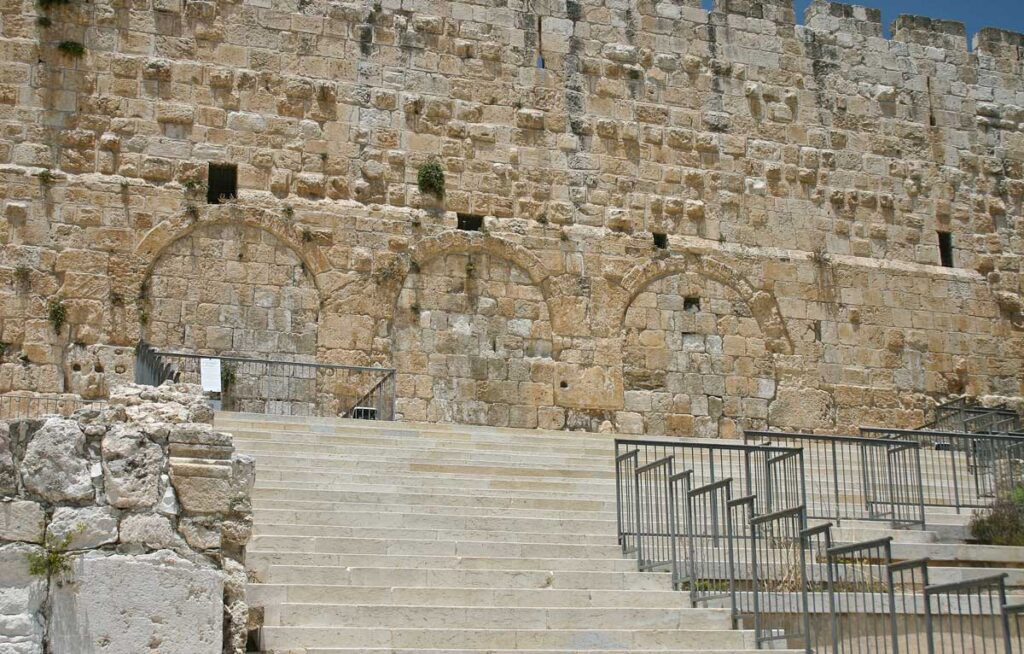
Modern recreation of the steps leading to the uncovered triple gates. These gates were blocked during the Middle Ages. (Credit: holylandphotos.org) A modern illustration is shown below (public domain).

Excavation of the eastern Ophel is now in process. To date, a complex consisting of a large, monumental building, a porch with entrances and staircases leading to a stepped pool, pathways, a tunnel-complex, cisterns – all at the foot of the large staircase climbing to the Triple Gate entrance of the Temple complex. How all this can be integrated for an understanding of its pilgrimage function must await further excavation.

Conclusion

What is already clear about the Ophel is that it facilitated the ritual purification and traffic needs of the thousands of pilgrims at the time of Jesus. Such crowds are somewhat unusual since there is little evidence of this in the decades prior to Jesus. The earlier rededication of worship in the Herodian Temple by the Maccabees (164 B.C.), its final building completion in the first century A.D., and the subsequent construction of facilities to accommodate hordes of pilgrims reached a climax about the time of Jesus. As a result, Messiah Jesus was exposed to the maximum number of Jews from throughout the Empire. Perhaps this is another example of God’s providential guidance of history to facilitate the extensive spread of the Good News of salvation: “But when the fulness of the time came, God sent forth His Son…” (Galatians 4:4).

Source: Biblical Archaeology Review, Fall 2025, pp. 40-47

Written by Dr Don Bierle · Categorized: Bible, Happ-O-Getics Newsletter

Jul 22 2025

Ancient Israel: Faith or Fact?

A common accusation by some of Israel’s neighbors and protesters in the U.S. is that Israel today is guilty of occupying the Palestinians’ homeland. As recently as 2016, the United Nations Educational, Scientific and Cultural Organization (UNESCO) approved a resolution that Jerusalem is indeed significant – but only to Islam, not to Israel. According to the declaration, Palestinians are the only true indigenous people. UNESCO’s position is that the Old Testament is not historical, and that the Jews had no ancestral connection with the Holy Land or an ancient Israel. The resolution maintained that there never was a Jewish kingdom under a real king David a thousand years before Jesus Christ came. Thus, the Jews had no rights to Jerusalem, the Temple Mount, and Palestine. They were an “occupying power” – in other words “colonialists.”

Let Ancient Israel’s Stones Speak

Recent excavations in Jerusalem are dealing a fatal blow to the rampant propaganda and historical revisionism which denies that the Jewish people have been indigenous to the land for more than 3,800 years. These discoveries are also reaffirming the historicity of the Bible and a real ancient Israel.

[Read more…] about Ancient Israel: Faith or Fact?

Written by Dr Don Bierle · Categorized: Bible, Happ-O-Getics Newsletter

Sep 12 2024

Ancient Ephesus and the Gospel

The apostle Paul desired to take the Gospel to ancient Ephesus early in his missionary tours, but was forbidden by the Holy Spirit (Acts 16:6). At the end of the second tour, He still wanted to do so and expressed, “I will return to you again if God wills” (Acts 18:21).

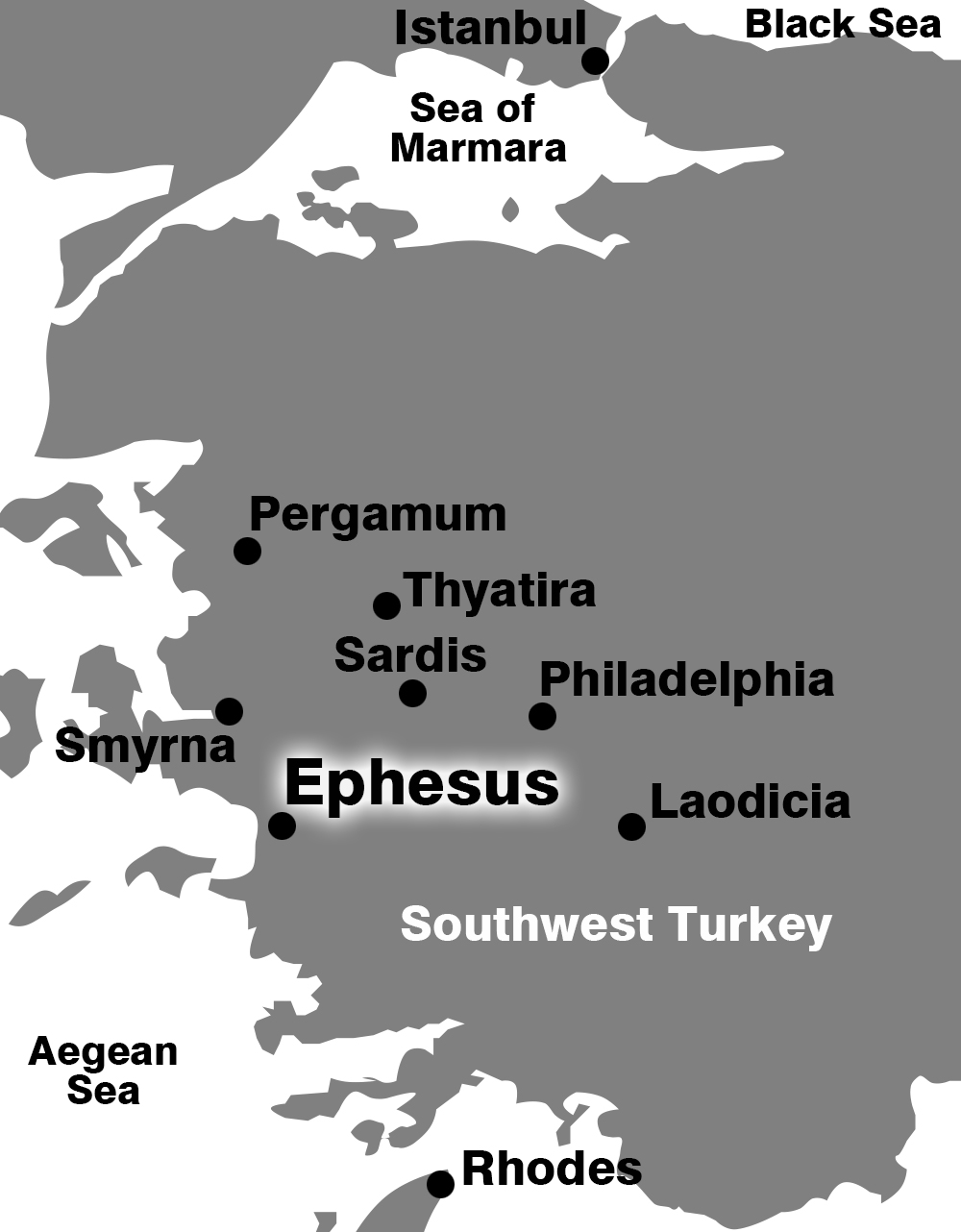
Ancient Ephesus Map
The location of Ephesus among Paul’s “seven churches of Asia” in modern day southwest Turkey.

Evidently God did will it for he went straight to Ephesus in his third tour and after three years of teaching there, we read in Acts that “all who lived in Asia heard the word of the Lord, both Jews and Greeks” (19:10). Paul’s teaching assuredly resulted in the seven churches of Asia to be started (Revelation 2-3).

[Read more…] about Ancient Ephesus and the Gospel

Written by Dr Don Bierle · Categorized: Bible, Happ-O-Getics Newsletter

Aug 01 2024

Was Jesus Literate?

In the last issue of Happ-O-getics, I challenged the view held by some scholars that the illiteracy rate among people at the time of Jesus was at least 98% (they could neither read nor write). Based on the many libraries and volumes of written documents that existed even then, the statistic is quite unlikely. This leads us to ponder another question: was Jesus literate? 

I also quoted Helen Bond, a professor of Christian Origins at the University of Edinburgh who said, “If Jesus was a carpenter/mason, as we generally suppose, then it’s not impossible that he had some rudimentary grasp of letters and/or numbers for the purposes of his trade, but I think it very unlikely that Jesus could read or write.” 

In this issue, I want to challenge the naivety or nonsense of this statement regarding Jesus. 

[Read more…] about Was Jesus Literate?

Written by Dr Don Bierle · Categorized: Happ-O-Getics Newsletter, Jesus

Apr 18 2024

The Apostolic Fathers 

Anyone who is acquainted with the Bible should be familiar with the apostles of Jesus. References to Peter, Paul, James, John, and others occur throughout the New Testament. Many people have also heard the names of some of the great apostolic fathers of the Christian faith such as Augustine, Irenaeus, Origin, and others. 

[Read more…] about The Apostolic Fathers 

Written by Dr Don Bierle · Categorized: Bible, Happ-O-Getics Newsletter

  • Page 1
  • Page 2
  • Page 3
  • Go to Next Page »

Primary Sidebar

Categories

  • Bible
  • Creation vs Evolution
  • Faith
  • God
  • Happ-O-Getics Newsletter
  • Jesus

Recent Posts

  • The Ophel: Facilitating Jerusalem Pilgrimage
  • Ancient Israel: Faith or Fact?
  • Jesus, our Mercy Seat
  • Ancient Ephesus and the Gospel
  • Was Jesus Literate?

Copyright © 2026 · FaithSearch International · Log in

Login

Lost Your Password?
Register
Don't have an account? Register one!
Register an Account